Field Notes
My Soil pH Was 8.0 All Season. Here's What I Learned.
In Zone 6b Connecticut, alkaline soil isn't just possible — if you're gardening over native New England bedrock, it may be exactly what you're dealing with, and it may not budge the way you expect. I found this out the hard way across four raised beds this spring, after weeks of amendments, conflicting advice, and a Reddit thread that reframed the whole problem.
Here's what I tried, what the soil actually did, and what experienced growers told me I'd gotten wrong.
How I Found Out My Soil Was Alkaline
It started with a 3-in-1 soil meter and a question I asked my gardening app: what's the ideal pH for peas?
The answer was 6.0–6.5. My reading was 7.5–8.0.
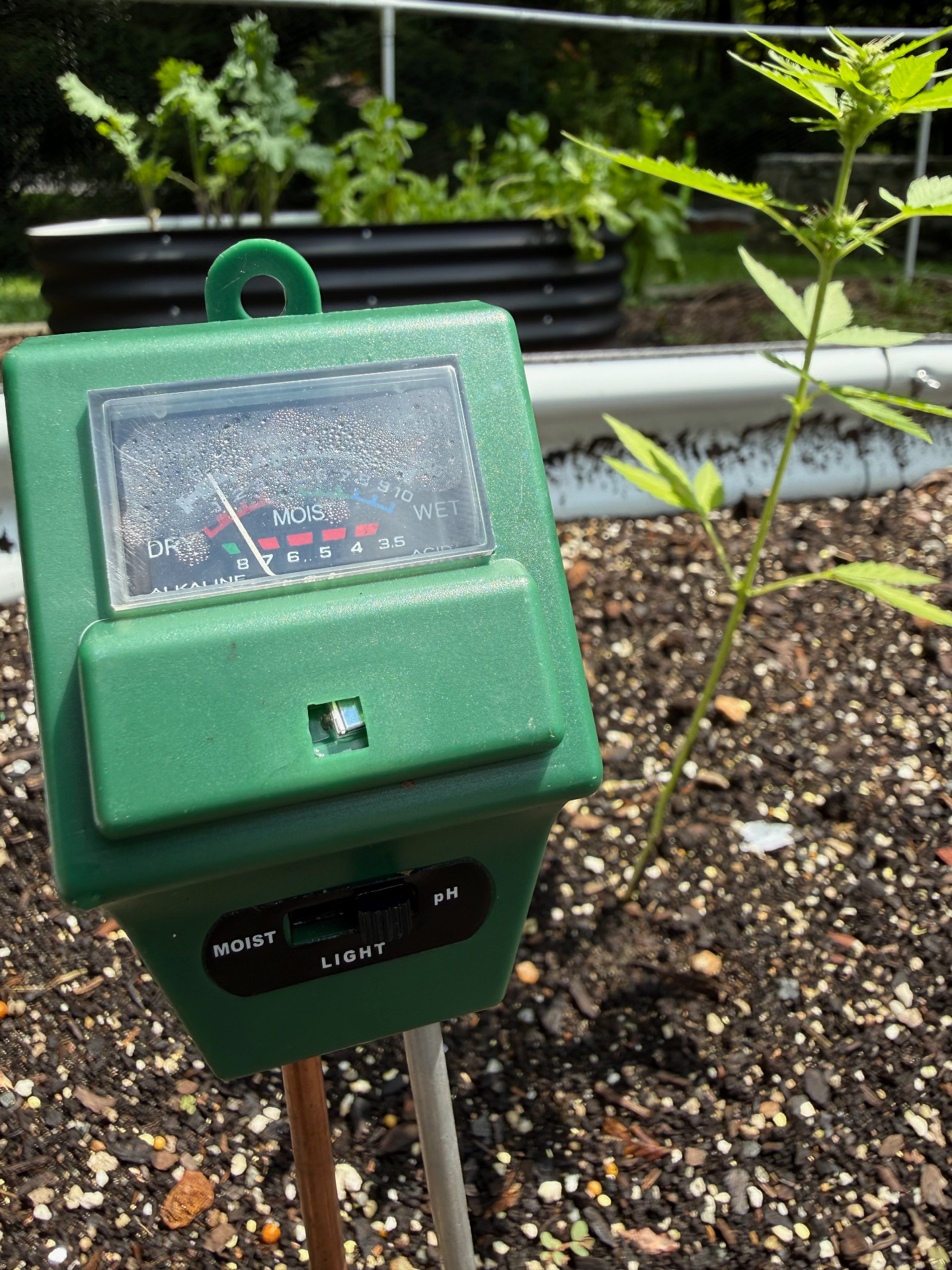
That was late April, in Bed 2, a week after my pea seedlings had just emerged. I noted it in my journal and moved on, assuming it was a minor issue I'd correct quickly. It wasn't minor, and it wasn't quick.
Over the next three weeks, as I tested across all four beds, I found the same story everywhere:
- Bed 1 (carrots): pH 8.0–8.1 at surface, 8.0–8.5 at mid-depth, 8.5+ at full depth
- Bed 3 (kale + lettuce): pH 7.8–8.0 throughout all depths
- Bed 4: pH 8.0–8.5 across all depths
The most likely culprit: the native Connecticut soil underneath. I'd added Miracle-Gro topsoil on top of it, but the alkalinity has held steady at ~pH 8 consistently across all four beds — and still does. That kind of persistence through an entire season of amendments points to the native soil parent material, not what I put on top. The well water — hard water, not municipal — probably isn't helping either, as one commenter in the Reddit thread later pointed out.
Why High pH Is a Problem (And Why It's More Complicated Than That)
The textbook explanation: alkaline soil doesn't kill plants — it locks nutrients out. At pH 8.0, iron, manganese, and phosphorus all become less soluble. They exist in the soil, but plants can't access them efficiently. The plant is starving in a fully stocked pantry.
My app told me the target range for most vegetables is 6.0–7.0, and that at 8.0+ I was outside that window by a meaningful margin.
I'll come back to whether that framing was the right one.
What I Tried to Lower the pH
Coffee Grounds (April into Early May)
The first thing I reached for was coffee grounds — free, acidifying, widely recommended. I applied a full bag around the pea trough perimeter, mixed it in, and watered. Then did the same around the carrot bed.
My app flagged the pea application immediately: too much, too fast, applied too close to the center where the sprouts were. Coffee grounds can form a hydrophobic crust when over-applied, blocking water penetration.
More fundamentally, coffee grounds are a slow and mild acidifier. They work over weeks, and the effect is subtle. For a bed sitting at pH 8.0+, they're the right general direction but the wrong magnitude.
By early May, the carrot sensor readings were still showing high 7s to low 8s.
Verdict: Good supplement, not a solution at this scale.
Garden Sulfur — Too Much, Too Fast (Early May)
On May 2nd I picked up a 30-pound bag of hydrangea/blueberry sulfur soil acidifier and spread it across three beds, then turned the soil to 5–7 inch depth.
My app calculated what I hadn't: I'd applied roughly 8x the recommended rate.
Here's what I hadn't understood about sulfur: it doesn't work immediately. Sulfur granules need soil bacteria to convert them into sulfuric acid — an aerobic process that requires warm, moist, well-oxygenated soil. Apply too much and you risk overshooting into acidic territory weeks later. Apply it into waterlogged, anaerobic soil and nothing happens at all.
Which leads to the next problem.
Verdict: Directionally right, badly dosed, into the wrong conditions.
The Waterlogging Problem (Mid-May)
By May 13th — a date I have logged across every bed — the moisture situation had become its own crisis running parallel to the pH problem.
Bed 3 (kale + lettuce): dry crust at 2.5–3/10, severely waterlogged at midpoint (9.5/10), waterlogged at depth (10/10). Bed 1 (carrots): surface dry at 2.5/10, acceptable mid-depth, very moist at full depth.
It had been a wet spring. More rain was expected. The sulfur I'd applied two weeks earlier was sitting in anaerobic, saturated soil doing essentially nothing. Sulfur bacteria can't work without oxygen.
The soil needed to dry before pH correction could even begin. I stopped watering entirely and waited.
Verdict: The pH problem and the waterlogging risk were compounding each other. Fix drainage first — waterlogged soil blocks sulfur activation entirely.
The Recommendation I Didn't Follow (Mid-May)
With beds waterlogged and sulfur stalled, my app suggested a diluted white vinegar drench as a short-term bridge — approximately one cup per gallon of water, applied lightly to the soil surface. Vinegar is acetic acid; it lowers pH immediately but temporarily, washing away within days.
I didn't do it. At that point I had waterlogged beds, over-applied sulfur, and a growing skepticism about whether any of this was actually moving the needle. Adding another intervention on top of two that weren't working felt like compounding the chaos. I let the soil dry and waited.
In hindsight — and based on what the Reddit community said later — skipping it was probably fine. A temporary surface nudge on native CT soil at pH 8 wasn't going to change the story.
What Reddit's Soil Community Said
By late May, the kale bed was finally showing movement — surface pH had dropped to 7.5–7.6 as soil dried and temperatures rose. The carrot bed was still 7.9–8.0. Still frustrated, I posted to r/Soil:
"All my beds are alkaline to 7.7+. I've added soil acidifier — over-added, to be more precise — but the pH still isn't coming down. It's been ~4 weeks and it seems like it's going up. Any tips on how to move the needle fast?"
The responses reframed the problem entirely.
On whether 7.7 is even a crisis: Multiple experienced growers said it isn't, for most vegetables. One commenter put it directly: most plants are perfectly happy at 7.7 with good soil fertility, and really only acid-loving plants are likely to struggle. A UConn soil testing resource shared in the thread showed most nutrients remain at least somewhat accessible to most plants across a pH range of 5.5–8.5 — a much wider window than my app's 6.0–7.0 target had implied. For Connecticut gardeners, UConn's Soil pH and Management page is worth bookmarking.
On timeline: Two commenters independently said pH correction takes months to years, not weeks. One suggested not retesting for at least two months after amending. I had been testing every few days.
On the real fix: A PhD soil scientist in the thread said: "Mix in as much organic matter as you can. That's the answer to almost all soil issues outside of severely contaminated soils." His recommendation: a 50-50 mix of garden center compost and fine woody debris mulch. Not sulfur. Not vinegar. Organic matter.
On AI and soil advice: One commenter flagged something worth knowing: AI gardening advice about soils may be drawing from research calibrated for entirely different regions — recommendations from UC-Davis or NC State may not be appropriate for Connecticut soils, and AI is often unable to tell the difference.
That's a fair point, and I think it applies specifically to soil chemistry. But it's worth being precise: the same app that pointed me toward an aggressive pH correction protocol also correctly diagnosed leaf miners on my kale, flagged the waterlogging risk before I'd connected the moisture readings to the drainage problem, and gave me a solid framework for the carrot thinning experiment I've been running all season. For in-the-moment plant diagnosis, pest identification, and general growing guidance, it's been consistently useful. Soil chemistry in a specific regional context is where the limits show up. A local extension office or regional soil test lab will always know your soil better than a model trained on generalized research.
What I Said Back — And Whether I Was Chasing Windmills
Reading those comments, I typed something that was more honest than I'd been with myself all spring: "Honestly, it worked for me last year (though I wasn't measuring) and we do have hard water. It's my second season and I'm using AI tools to guide me which are saying I need to get down to 6.5–7. But my harvest last year was still good. Maybe I'm chasing windmills?"
The community's answer was essentially: yes, a little.
The consensus:
- pH 7.7 is workable for most vegetables — not ideal, but not a crisis requiring emergency intervention
- Organic matter is the right long-term lever, not aggressive sulfur application
- pH moves in months to years, not weeks — I was measuring too soon and expecting too much
- Native soil parent material and well water are factors that amendments can't quickly overcome, and may not need to
This directly contradicted the framing my app had been operating from. The app treated 6.0–7.0 as a firm target to correct toward immediately. The Reddit soil scientists treated it as a range to approach gradually while focusing first on building soil biology.
What the Plants Actually Did
Here's the data point that should have told me something earlier: my harvest last year was good. I wasn't measuring pH then. My plants didn't know they were in soil that was supposedly too alkaline. They just grew.
This year, same beds, measured everything: the kale pushed through pH 8.0, survived waterlogging, showed some legginess and stress early on, and produced a full canopy I was still harvesting in July. Buttercrunch lettuce germinated and made it to two substantial harvests. Danvers Half Long carrots are on track for a summer pull despite pH that never reached my app's target.
The crops were more resilient than the chemistry suggested they'd be.
What I'm Taking Away
On the pH target: 7.7–8.0 isn't a crisis for most vegetables. The 6.0–7.0 window is real, but the edges aren't cliffs. Soil at pH 8 with good organic matter and fertility will grow most things. Acid-loving crops — blueberries, potatoes — are the exception.
On organic matter: I've been chasing numbers on a meter when I should have been adding compost. The PhD soil scientist's 50-50 compost and woody mulch recommendation is going into the fall prep plan.
On AI advice for soil: It can give you a framework and flag problems. For soil-specific recommendations in your specific place, layer in local sources — your county extension office, a regional soil test lab, and ideally a UConn or land-grant university resource calibrated for your region.
On timeline: pH moves in months and years. Testing at four weeks and expecting dramatic change was like weighing yourself the morning after a salad. Add organic matter. Stop retesting so often. Wait.
Part 2: What I'm Doing for Fall
This is Part 1 of an ongoing series. By fall I'll have a full season of data, an actual lab soil test replacing the 3-in-1 sensor readings I've been working from, and a compost-forward amendment strategy to test against what I did this spring.
The plan for fall prep, the actual before/after numbers, and whether any of this spring's amendments actually moved the needle: that's Part 2.
If you're gardening in raised beds with alkaline soil and panicking about the numbers, the short version is this: build organic matter, give it time, talk to your local extension office, and check what your plants are actually doing before you over-apply anything. They may already be telling you something your meter isn't.
Frequently Asked Questions
At pH 8.0+, nutrients like iron, manganese, and phosphorus become less soluble, meaning plants struggle to absorb them even if they're present in the soil. This can cause yellowing leaves and stunted growth. However, most vegetables can tolerate pH up to 7.7–8.0 with good soil fertility and organic matter — only acid-loving plants like blueberries and potatoes are likely to show significant stress.
Meaningful pH reduction typically takes months, not weeks. Elemental sulfur requires warm, moist, well-oxygenated conditions for soil bacteria to convert it to sulfuric acid, and even under ideal conditions, significant shifts take 2–6 months. Native soil parent material and hard water can continue pulling pH upward, slowing progress further. Don't retest sooner than 6–8 weeks after amending.
No. Garden sulfur requires aerobic soil bacteria to convert it into sulfuric acid, a process that takes weeks under warm, moist, well-aerated conditions. In waterlogged or cold soil, it does nothing. Over-application also risks overshooting into acidic territory once conditions improve. It's the right long-term amendment but works on a timeline of months, not days.
Many vegetables can and do grow in soil at pH 7.7–8.0, especially with good organic matter and fertility. In my Zone 6b Connecticut garden, kale, lettuce, carrots, and peas all produced through a full season despite pH holding at 8.0 across multiple beds. The key is building organic matter, which improves nutrient availability and soil biology regardless of pH. Acid-loving crops like blueberries and potatoes will struggle more noticeably.
The most common causes are alkaline native soil parent material underneath the bed, hard water used for irrigation, and some commercial topsoil mixes that run slightly alkaline. In Connecticut and similar New England regions, native bedrock can keep soil persistently alkaline even through multiple seasons of acidifying amendments.
For most garden situations, building organic matter is the more practical long-term strategy. Organic matter improves soil biology, nutrient availability, and structure in ways that help plants access nutrients even at higher pH levels. Sulfur can lower pH over time but is slow, requires specific soil conditions to activate, and doesn't address the underlying soil biology. A 50-50 mix of compost and woody mulch is a commonly recommended starting point.