
Field Notes
Leaf Miners on Kale: What I Found and What I Did
Leaf miners rarely kill kale — but finding squiggly white tunnels all over your leaves for the first time is alarming enough that you'll want to know exactly what you're looking at and what to do about it.
I grow Heirloom Red Russian kale in Bed 3 here in Ridgefield, Connecticut (USDA Zone 6b). On June 19th — 42 days after sowing — I logged a new observation in my garden journal: white and yellowish streaky lines on the leaves in a squiggly, serpentine pattern. I'd never seen it before. My first instinct was disease. It wasn't.
By June 29th, the plants had grown into a full, healthy canopy. The leaf miner damage was visible only on the lower, older leaves. There was no active infestation on new growth. I harvested my first round of outer leaves that same day. Here's what happened between those two dates.
What leaf miner damage looks like
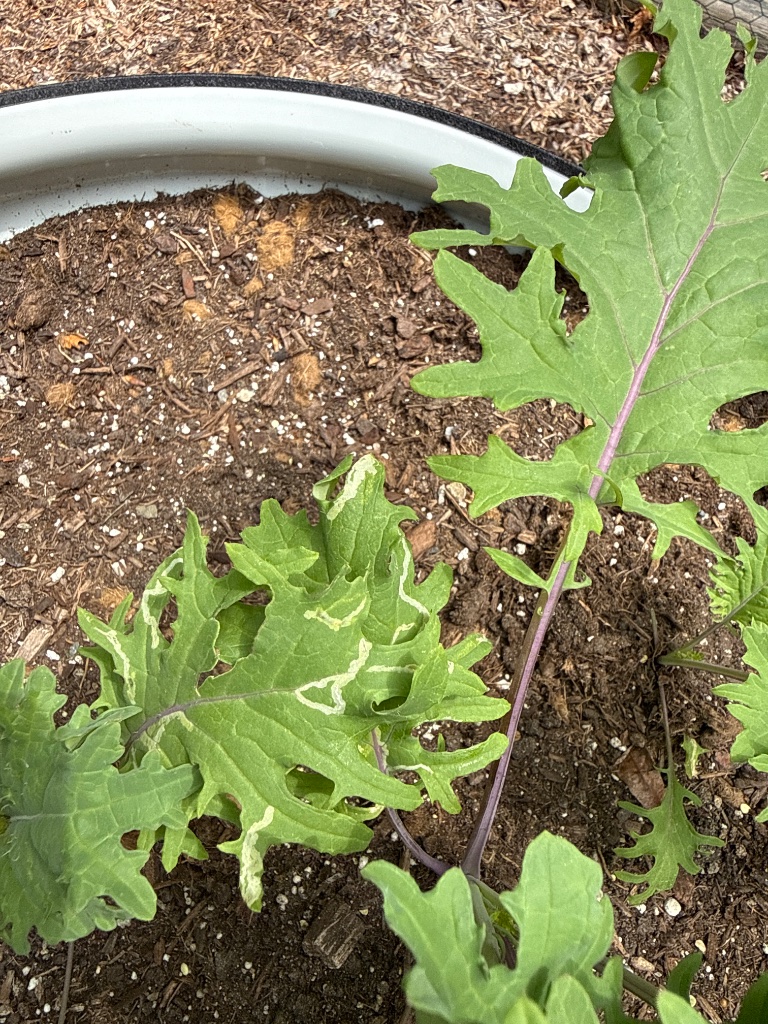
The pattern is unmistakable once you know it: thin, pale lines that wind through the leaf in irregular curves — like a tiny creature drew a road map inside the leaf. Which is exactly what happened.
Leaf miners are the larvae of small flies (in the Liriomyza genus and related species). The adult fly lays eggs on the leaf surface, and the larvae hatch and tunnel between the upper and lower leaf layers, feeding on the tissue inside. The trail they leave behind is the tunnel — that's the squiggly white or yellowish line you're seeing.
The non-obvious thing: you can usually find the larva itself at the leading (darker, slightly wider) end of the trail. That's where it currently is. The older, lighter portion of the trail is where it has already been.
How I confirmed the diagnosis
I looked closely at several affected leaves and traced the trails to their leading ends. In some cases I could see a tiny pale speck — the larva — visible through the leaf skin if I held it up to the light. This confirmed it wasn't a disease or nutrient deficiency. The serpentine pattern and the larva at the trail end are the two diagnostic tells.
I also checked the undersides of leaves for egg clusters — small white oval eggs, usually laid in groups of a few, on the underside near the midrib. Finding eggs told me the population was still active and would expand without intervention.
What I did about it
My approach was manual and daily. No sprays.
Step 1 — Crush larvae through the leaf. For any trail with a visible larva at the leading end, I pinched the leaf firmly between my thumb and fingernail right at that spot. You can feel a tiny amount of resistance. Done. The larva is dead without opening the leaf or removing it.
Step 2 — Remove the most heavily damaged leaves. Leaves where more than half the surface was consumed came off entirely. These went in the trash (not the compost — no point keeping potential pupae in the garden). Lightly damaged leaves stayed on the plant.
Step 3 — Check undersides for eggs daily and crush them. This is the part that actually stops the next generation. A small white egg cluster, crushed between two fingers, is one less round of larvae in two weeks. I did this every day for about a week, then every other day as egg-laying activity dropped off.
The plants kept putting out new growth the entire time. The new leaves coming in above the damage zone were clean.
The outcome at day 52 (June 29th)
By June 29th — 10 days after first noticing the damage — my Red Russian kale had grown into a full, healthy canopy. The leaf miner evidence was limited to the lower and outer leaves that had been affected in mid-June. All new growth above that was clean.
I started my first cut-and-come-again harvest: outermost and lowest damaged leaves came off first (they were the oldest anyway), never taking more than a third of the plant. The kale I harvested was perfectly fine to eat — you wash it, you cook it, and whatever was in those lower leaves stays in the compost.
The plants are still in the ground. I'll check again in 7–10 days. If you're keeping a garden journal, this is exactly the kind of dated observation chain that pays off the next time you see those squiggles. For the earlier chapter of this same bed, see Kale, Lyme, and Leaf Miners.
Is kale with leaf miners safe to eat?
Yes. Leaf miner damage is cosmetic. The larva eats the tissue inside the leaf, but it doesn't introduce toxins or pathogens. Wash your kale well, remove heavily damaged leaves if you want, and cook or eat the rest normally. You won't taste anything from the mining, and there's no food safety concern.
This came up in a gardening forum thread I checked while dealing with this: the general consensus among experienced growers is that mild leaf miner pressure isn't worth losing sleep over. The kale will grow through it. The main reason to intervene is to protect future growth and slow the population — not because the harvested leaves are dangerous.
Frequently Asked Questions
Leaf miners are larvae of small flies in the Liriomyza genus. Adult flies lay eggs on kale leaves (usually on the underside), and when the eggs hatch, the larvae tunnel through the leaf tissue, creating the characteristic serpentine white or yellowish trails.
The most effective no-spray method is manual removal: crush larvae at the leading end of each trail by pinching through the leaf, remove heavily damaged leaves, and check daily for new egg clusters on leaf undersides to crush before they hatch. Consistent daily monitoring for 1–2 weeks is what breaks the cycle.
Leaf miner eggs are small, white, and oval — typically laid in groups of 2–10 on the underside of leaves near the midrib or main veins. They're small but visible if you look closely in good light.
Yes. Leaf miner damage is cosmetic and doesn't make kale unsafe to eat. Wash the leaves thoroughly, remove any leaves with extensive tunneling if preferred, and eat the rest normally.
Rarely. Heavy infestations on young seedlings can cause enough damage to set plants back, but established kale plants typically tolerate moderate leaf miner pressure and continue producing. New growth above the damage zone usually comes in clean.