Field Notes
Should You Thin Carrots? I Ran the Experiment to Find Out
Every gardening guide, every Reddit thread, every AI advisor says the same thing: thin your carrots or you'll end up with forked, crowded, pencil-thin roots. I decided to test that instead of just following it.
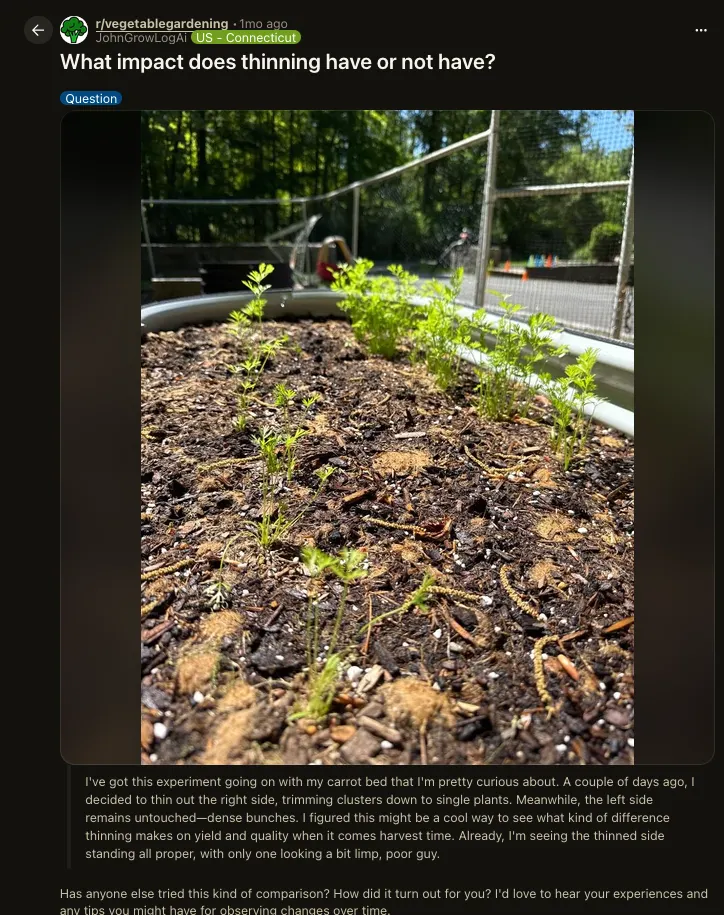 The experiment question I posted to r/vegetablegardening while the test was still running.
I grow Danvers Half Long carrots in Bed 1 here in Ridgefield, Connecticut (USDA Zone 6b). This is my second season growing vegetables, and I've been deliberately using my garden as a testing ground — not just a food garden. So when the thinning advice came from multiple directions at once, I did what I used to do in my marketing career when conventional wisdom seemed too tidy: I split the sample and ran the experiment.
One row thinned to 3-inch spacing. One row left completely alone. Same bed, same variety, same soil, same water. Here's what actually happened — and it builds directly on an earlier carrot thinning split test I set up in the same bed.
What the Conventional Wisdom Says
The case for thinning carrots is straightforward. Carrots develop a taproot that grows straight down and outward. When multiple plants compete for the same space, roots fork around each other, stay thin from nutrient competition, and sometimes grow in bizarre shapes just to avoid their neighbors.
The standard recommendation is to thin to one plant every 3 inches once seedlings reach 1–2 inches tall. Most sources are pretty emphatic about this: skip it, and you're trading yield for laziness.
When I asked my gardening app and checked the carrot threads on Reddit, both pointed the same direction: thin them. Makes sense on paper.
The Experiment Setup
I had two rows of Danvers Half Long in Bed 1, sowed April 17th. By early June — around day 47 — I had strong germination across both rows. I thinned the right side to one plant per 3-inch position, snipping at soil level with scissors rather than pulling (pulling disturbs neighbors). The left side I left completely untouched, dense clusters and all.
Then I waited. The full carrot development window for Danvers Half Long is 70–80 days from germination, so I let both sides run.
One thing I learned during this period: you can check carrot progress without pulling the whole plant. Just gently brush back the top inch of soil at the base of a plant to expose the shoulder — the orange top of the root where it meets the soil. The width of that shoulder tells you where the root is in development. Cover it back up when you're done. This saved me from the temptation of pulling too early.
The Result
By day 73 I brushed back soil on both sides and compared shoulders.
The unthinned left row had thicker shoulders than the thinned right row.
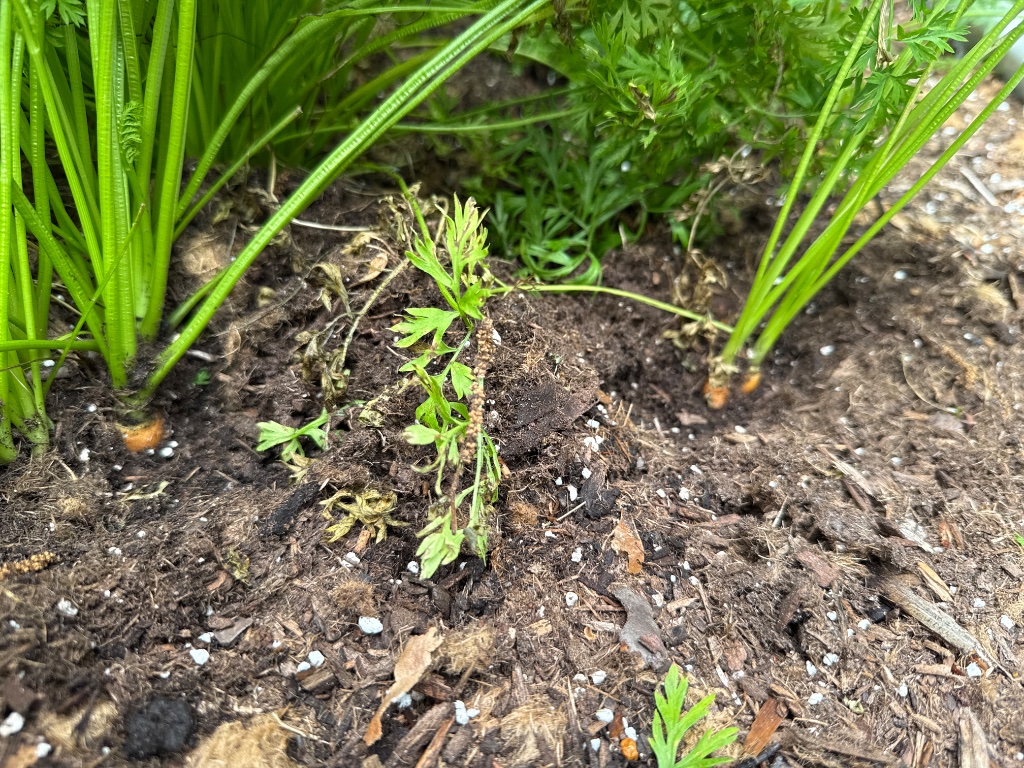 Day 73 shoulder check. Orange carrot tops visible on both sides — the unthinned left side came out ahead on root diameter.
I checked it twice because I didn't believe it the first time. The unthinned carrots — the ones that had been crowded the entire season, competing for space and nutrients — had grown thicker roots than the row I had carefully thinned to ideal spacing.
I should note: the thinned row isn't a failure. The roots look good, are on track for a clean harvest, and will likely be straighter and more uniform. But they are not larger. The core premise of the advice — thin to get bigger carrots — did not hold in my bed, in my soil, in my conditions.
Why This Might Have Happened
A few possible explanations, though I don't have enough data from one season to be certain about causation:
Soil conditions. Bed 1 has been working through pH correction since April — I've been managing alkalinity throughout the season. It's possible the soil environment mattered more than spacing, and the unthinned row happened to sit in a slightly better zone. I'd need to test again with consistent soil to rule this out.
Danvers Half Long is a forgiving variety. This is a chunky, adaptable carrot bred for less-than-ideal soil. It may handle crowding better than finer varieties like Nantes or Imperator. The thinning advice might hold more firmly for those types.
My thinning timing. I thinned relatively late — day 47. Some of the root development was already underway by then, which may have meant the thinned row didn't get the full benefit of reduced competition during the critical early growth window.
Any of these could be the real explanation. Or it's simply that in my specific garden conditions this year, the density didn't hurt and may have helped by shading out soil competition. One experiment doesn't settle the question.
What I'm Taking Away
Not "never thin carrots." The advice exists for real reasons and probably holds in many situations. What I'm taking away is narrower: gardening advice is context-dependent, and your garden is the only reliable source of truth for your garden.
I also noticed my Buttercrunch lettuce — which I never thinned at all — has been producing consistently through late June. That's another data point worth paying attention to next season.
The deeper habit I'm building is this: when everyone agrees on something, that's a good time to test it, not just follow it. Not out of contrarianism, but because uniform advice tends to come from average conditions. Your soil, your climate, your variety, your timing — none of those are average.
I'm planning to resow carrots in fall and run the same split again with better-controlled conditions. The journal entry from this experiment will be the starting point.
Frequently Asked Questions
Most gardening sources recommend it strongly to avoid forked, crowded roots. But thinning outcomes depend on variety, soil conditions, and timing. My single-season experiment in Zone 6b showed unthinned Danvers Half Long roots developed comparable or larger shoulders than thinned ones — worth testing in your own garden before treating it as a hard rule.
Use scissors to snip at soil level rather than pulling. Pulling disturbs the root systems of neighboring plants you want to keep. Thin when seedlings are 1–2 inches tall, targeting one plant per 3 inches of spacing.
Gently brush back the top inch of soil at the base of a carrot plant to expose the shoulder — the orange top of the root where it meets the surface. A shoulder width of ¾ to 1 inch typically indicates a mature Danvers Half Long. Cover the soil back afterward and leave the plant in the ground until you're ready to harvest.
The standard recommendation is when seedlings reach 1–2 inches tall, typically 2–4 weeks after germination depending on soil temperature. Thinning later still helps but the root competition benefit is reduced since development has already begun.
Forking is most often caused by rocky or compacted soil, not crowding — the taproot splits to get around an obstacle. Thinning helps prevent thin, stunted roots from competition, but if your carrots are forking, the soil itself is the more likely culprit.