Field Notes
Bent Carrots? A Live Thinning Experiment in Raised Bed 1
The setup
As I learned with my kale, planting too many seeds together means you eventually have to thin the bunches so a single plant can thrive. And even then, thinning doesn't always guarantee the remaining plant survives.
So I made a split decision in my garden.
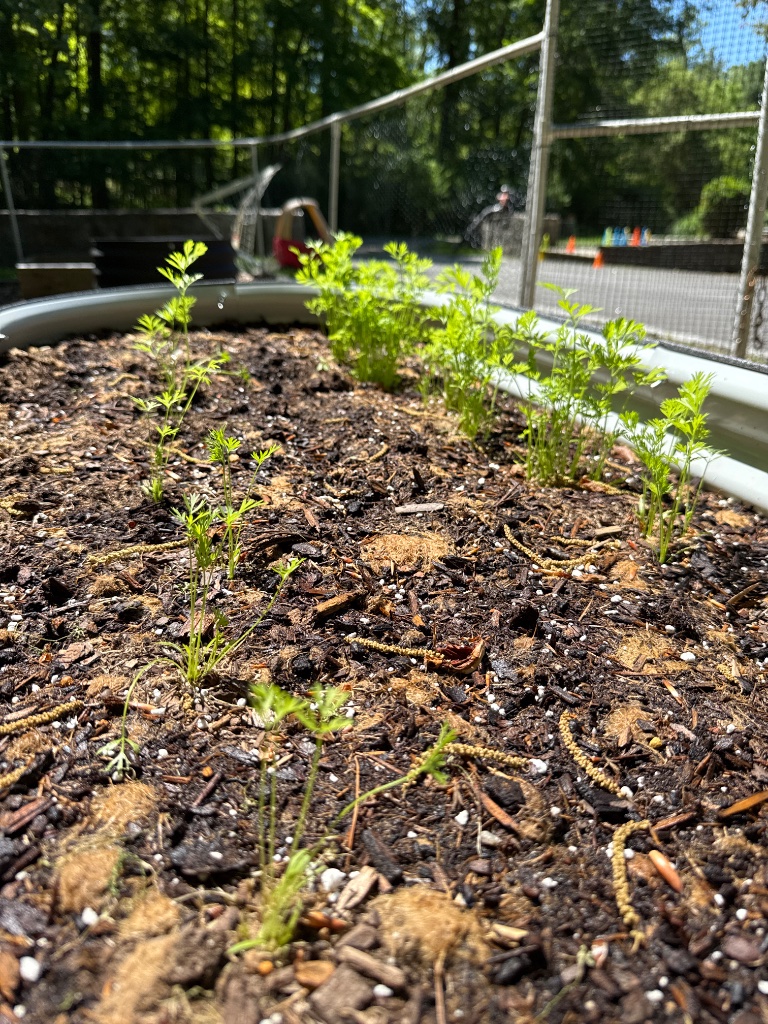
In Raised Bed 1, I thinned the right side to single plants, spaced comfortably apart. The left side? I left it exactly as it sprouted — a crowded patchwork of green. I'm genuinely curious which approach will yield better results at harvest.
What the guides say
Everything I've read about thinning suggests the same thing: bunched carrots compete for nutrients, water, and light. The result? Forked, bent, or stunted roots. Conventional wisdom is clear — thin early, thin aggressively, give each carrot the space to grow straight and full.
But part of me wonders about the power of nature to adapt and thrive when left dense.
Will the crowded carrots avoid forking by growing away from the center of the bunch? Will I get a bunch of two-headed monsters? Will they just bend and weave around each other?
What I'm watching for
This is an experiment in progress, and I genuinely don't know which side will be the "victor" at harvest.
- Will the bunches grow as well? The thinned side has every advantage on paper — space, less competition, easier access to nutrients.
- Will the carrots be malformed or forked? My garden advisor says they will be. The gardening books agree.
- Can density actually work? Some plants seem to benefit from neighbor pressure. Maybe carrots have a trick I haven't read about.
Right now, I'm just watching. Seeing how these plants unfold their stories is half the point.
The real lesson
Setting up this thinning experiment reminded me that sometimes the biggest insights come from the uncertainty of trying something new.
Leaving part of the carrot bed unthinned gives me a live comparison that could defy conventional wisdom — or reinforce it. Either way, it's the gritty truth that no guidebook can provide. Just hands-on experience as I wait to see which side is healthier.
That's the part of gardening nobody can outsource: being present, observing closely, and letting the plants teach you something the reading never could.
I'll update this post at harvest with the results. If you're running your own garden experiments, log them — the comparison data is worth more than any single-season yield.